A kitchen faucet is far more than a simple valve for controlling water flow; it's the central hub of your kitchen, impacting your daily cooking and cleaning efficiency. As a sanitary ware expert with 38 years of experience, this guide will walk you through the various types, functions, and components of kitchen faucets to help you fully understand this essential kitchen fixture and make an informed purchase.
Deconstructing the Kitchen Faucet: Core Components
To truly understand what a kitchen faucet is, you must first know its anatomy. A faucet is composed of several key parts working in unison:
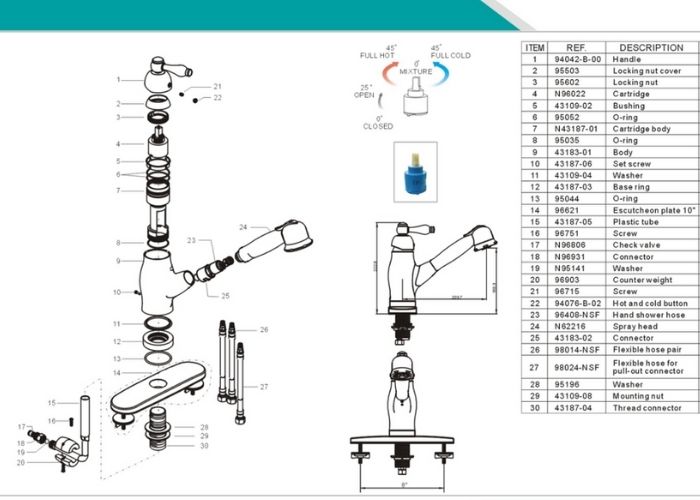
- Cartridge: This is the heart of the faucet, responsible for controlling water flow and temperature. The quality of the cartridge directly determines the faucet's lifespan and operational feel.
- Body: The main housing of the faucet, typically made of brass or stainless steel. Its material and construction define the faucet's durability and health safety.
- Spout: The tube through which water travels. Its height and shape—such as a high-arc gooseneck design—determine the amount of workspace available over the sink.
- Aerator: Located at the tip of the spout, it mixes air into the water stream, creating a softer, non-splashing flow while also conserving water.
- Handle: Used to operate the cartridge, available in single-handle and two-handle configurations.
- Supply Lines: Flexible hoses that connect the faucet body to the angle stops on the wall, bringing hot and cold water to the faucet.
- Angle Stop Valves: Installed between the wall and the supply lines, these valves control the water supply to the faucet and allow you to shut it off for repairs.
- Escutcheon Plate: A decorative plate used to cover any extra, unused mounting holes on the sink deck.
Expert Tip: When shopping for a faucet, always ask about the cartridge type. High-quality modern faucets universally use ceramic disc cartridges. They are extremely wear-resistant and create a perfect seal, ensuring a long, drip-free life, far superior to older rubber washer or ball-valve cartridges.
A Complete Breakdown of Kitchen Faucet Categories
To provide a clear understanding of the diversity of kitchen faucets, I will classify them based on function, operation, installation, material, and finish.
1. By Function & Technology
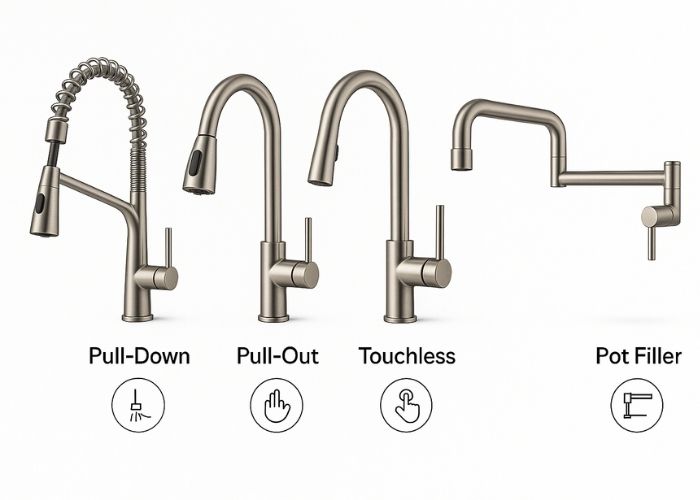
Modern kitchen faucets have evolved far beyond simple hot and cold mixing, incorporating user-friendly technology to make your kitchen tasks easier and more hygienic.
- Hot & Cold Mixer: The most basic function, allowing for temperature control by mixing hot and cold water.
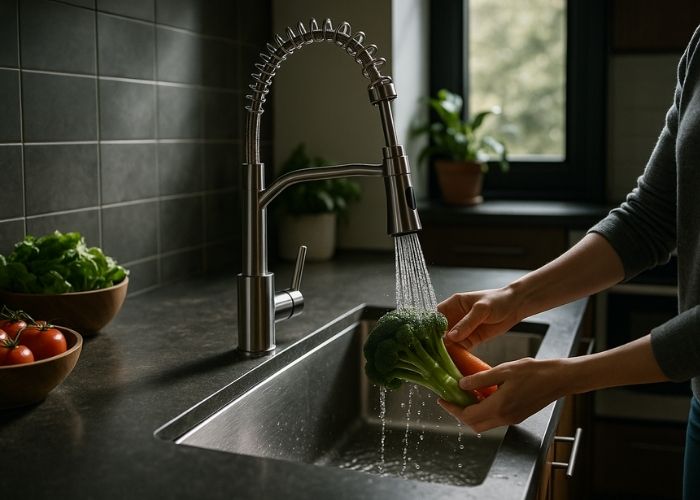
- Pull-Down/Pull-Out Faucet: The absolute mainstream choice for modern kitchens, significantly extending the faucet's working range. Rinsing the sink corners or filling a tall pot on the counter becomes effortless.
- Pull-Down: The spray head pulls down vertically, often paired with a high-arc gooseneck design, which is ideal for deep sinks.
- Pull-Out: The spray head pulls out horizontally. The faucet body is typically shorter, suiting kitchens with limited overhead space or shallower sinks.
| Feature Comparison |
Pull-Down Kitchen Faucet |
Pull-Out Kitchen Faucet |
| Pros |
High-arc design provides ample clearance for large pots; gravity helps the spray head retract smoothly. |
More compact body, suitable for tight spaces; the hose often extends further, allowing flexible filling of containers outside the sink. |
| Cons |
Requires sufficient vertical clearance; retraction might be weak if the counterweight is installed improperly or water pressure is low. |
Fewer design options available; repeated pulling can cause more wear on the hose and its connection point over time. |
| Best For |
Large, deep kitchen sinks, and island prep stations. |
Kitchens with overhead cabinets or limited vertical space, or shallower sinks. |
- Touchless/Motion-Activated Faucet: Activates water flow via a sensor, requiring no physical contact. This is especially useful for maintaining faucet cleanliness and preventing cross-contamination when handling raw meat or when your hands are greasy.
- Touch-Activated Faucet: Allows you to turn the water on or off by simply touching any part of the faucet with your wrist or the back of your hand, offering more convenience than a traditional handle.
- Voice-Activated Faucet: Enables precise water dispensing through voice commands, such as "dispense one cup of water," representing the cutting edge of smart home technology that further frees up your hands.
- Filtration Faucet: Integrates a water filtration system to provide purified drinking water directly from the tap, saving the space of an extra water purifier and offering a sleek, practical solution.
- Specialty Faucets:
- Pot Filler Faucet: Mounted on the wall above the stovetop, it features a long, articulated arm designed specifically to fill pots directly on the stove, eliminating the need to carry heavy, water-filled pots from the sink.
- Bar/Prep Faucet: Smaller in size, designed for small sinks in a bar or kitchen prep area.
- Beverage/Water Dispenser: Usually a small, cold-water-only tap that connects to a water filtration system to provide drinking water.
2. By Handle Operation
- Single-Handle Faucet: A single lever controls both water flow and temperature. It's user-friendly, has a modern, minimalist design, and is the most popular choice on the market today.
- Two-Handle Faucet: Provides separate controls for hot and cold water, allowing for more precise temperature adjustment. It has a classic, traditional look often found in farmhouse or vintage-style kitchens.
Expert Tip: A single-handle faucet is more practical in the kitchen. When one hand is holding a pot or ingredients, you can easily turn the water on/off and adjust the temperature with the other.
3. By Installation Type & Design Style
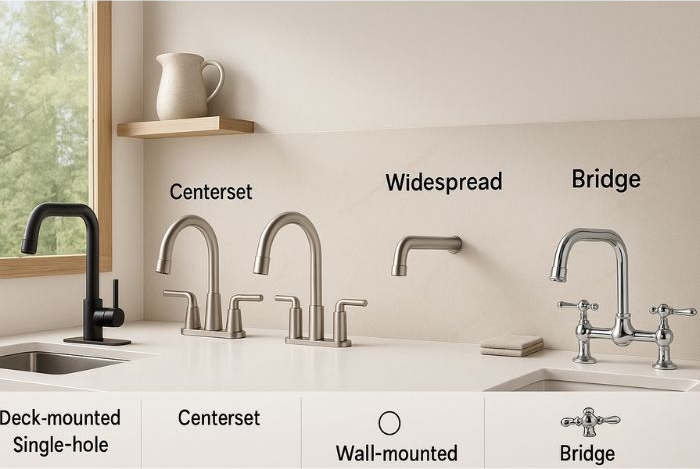
- Deck-Mount:
- Single-Hole: The entire faucet is installed through a single hole in the sink or countertop. This is the most common installation type in modern kitchens.
- Centerset: Designed for sinks with three closely spaced holes (typically 4-inch centers). The handles and spout are connected on a single base plate.
- Widespread: Also for three-hole sinks, but the two handles and the spout are separate components, allowing for more flexible spacing (typically 8 inches or more) and creating a more substantial look.
- Wall-Mount Faucet: Installed on the wall behind the sink. This frees up counter space, makes cleaning the countertop easier, and offers a unique, professional style often seen in commercial kitchens and vintage-inspired homes.
- Bridge Faucet: A vintage two-handle design where the hot and cold water inlets are connected to the spout by an exposed "bridge" pipe above the countertop, creating a distinctively elegant look.
4. By Body Material
The material not only determines a faucet's durability and health standards but also directly impacts its price.
| Material |
Pros |
Cons |
Price Range |
| Lead-Free Brass |
Best overall performance: durable, corrosion-resistant, antimicrobial; easy to manufacture into various designs; mature industry standards. |
Higher cost; beware of unscrupulous manufacturers using recycled brass with high lead content. |
Mid to High |
| Stainless Steel |
Completely lead-free, resistant to acid and rust; requires no electroplating as the material itself is the finish, making it more eco-friendly. |
Difficult to process, resulting in fewer style options; expensive, and feels lighter than brass. |
High |
| Zinc Alloy |
Extremely low cost, very affordable. |
Highly susceptible to corrosion and oxidation from water, short lifespan; may leach harmful metals over time, not recommended for the main body. |
Low |
| Plastic |
Lowest price, lightweight, available in many colors, doesn't corrode. |
Low strength, becomes brittle with age, not durable, can feel cheap. |
Very Low |
Expert Advice: The kitchen faucet is a high-frequency use item critical to your drinking water safety. I strongly recommend choosing a body made of lead-free brass or SUS304 stainless steel. Although zinc alloy faucets are cheap, their interiors can become horribly corroded within months, severely compromising water quality and lifespan.
5. By Surface Finish
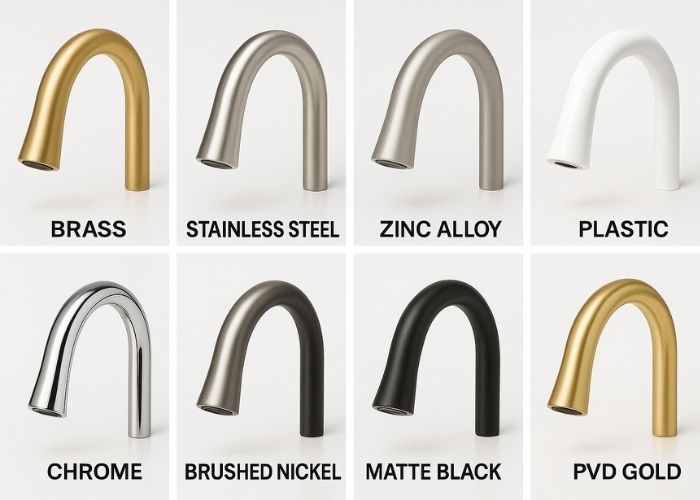
The surface finish not only gives the faucet its aesthetic appeal but also serves as a crucial protective layer, affecting its resistance to scratches and corrosion.
| Finish |
Appearance |
Pros |
Cons & Maintenance |
| Chrome Plating |
Mirror-like, bright, and classic; like a small mirror. |
High hardness, strong corrosion resistance, very easy to clean, and affordable. |
Its shiny surface tends to show water spots and fingerprints, requiring frequent wiping with a soft cloth. |
| Brushed Nickel |
A soft, matte metallic look with a fine, linear grain. |
Excellent at hiding fingerprints and water spots; durable and easy to match with stainless steel sinks. |
Should be cleaned in the direction of the grain to avoid marring the finish. |
| Matte Black |
Modern, minimalist, and industrial, with a unique non-reflective texture. |
Makes a strong, stylish visual statement and can become a kitchen's focal point. |
The painted surface can be scratched by hard objects or chipped; avoid abrasive cleaners. |
| PVD Finishes |
(e.g., Gold, Gunmetal, Rose Gold, Bronze). |
This is an industrial-grade finishing process. It's extremely hard, highly resistant to scratches and corrosion, and the color remains vibrant. |
Higher cost; this is often a hallmark of high-end faucets. |
| Oil-Rubbed Bronze |
A warm, dark brown retro finish with a hand-aged appearance. |
Unique style, perfect for American, classic European, and farmhouse decor. |
Some are "living finishes" that will develop a natural patina over time and with use, creating a unique character. |
- Match Your Sink & Space: Before buying, always confirm the number and spacing of the mounting holes on your sink. This will determine whether you need a single-hole, centerset, or widespread faucet. Also, measure the clearance below any overhead cabinets to ensure there is enough room for the high-arc faucet you want.
- Consider Your Habits: If you frequently wash large pots and pans, a high-arc pull-down faucet will be incredibly convenient. If you have elderly family members or children, a touch-activated or touchless faucet can offer added convenience and safety.
- Focus on the Core Component: To reiterate, the ceramic disc cartridge is a guarantee of quality. Within your budget, choosing a product with a cartridge from a reputable brand (like Sedal from Spain or Korex from Hungary) is a wise investment.
- Unify the Style & Finish: The faucet's color and shape should complement your sink, cabinet hardware, and the overall style of your kitchen. The right faucet can be the perfect finishing touch.
- Consider Brands & Service: Reputable brands like Kingston Brass, Delta, and Moen not only offer diverse product lines but also provide solid warranties and customer service, giving you more inspiration and peace of mind.
Expert Tip: When shopping in a physical store, pick up the faucet to feel its weight. Generally, a solid brass faucet will feel much heavier than one made of zinc alloy or other materials. Also, gently turn the handle to feel if its movement is smooth and without any sticking points—this is an intuitive way to judge the quality of the cartridge.
Choosing a kitchen faucet is a long-term investment. A high-quality model will not only enhance your daily experience but also safeguard your family's health and add lasting beauty to your kitchen.
Recommended Internal & External Links
- Authoritative Organizations:
- U.S. Environmental Protection Agency (EPA) WaterSense Program - For water-saving faucet standards: https://www.epa.gov/watersense
- NSF International - To verify safety certifications for drinking water products: https://www.nsf.org/
- Recommended Internal Links:
- Design Inspiration & Brand Resources:
- Kingston Brass Blog & Gallery: For product pairing inspiration.
- Brizo's World: To explore the design philosophy behind high-end faucets.


